If you're a UK electrician with a website that just sits there doing nothing, you're not alone. Most local electricians have a site that looks fine on the surface but quietly leaks potential jobs every single day.
This article is a practical self-diagnosis tool, not a sales pitch. You'll go through 9 clear warning signs that tell you when an electrician website redesign is overdue, what a proper rebuild actually includes, and how much it should realistically cost in the UK.
By the end, you'll know exactly whether your current site is helping you win work or quietly costing you customers. Grab your phone, open your own website, and let's go through it together.
Why Your Electrician Website Might Be Costing You Jobs (Not Winning Them)
Here's a quick reality check. When a homeowner in your area has a tripped fuse box at 7pm, they don't flip through Yellow Pages anymore. They Google "emergency electrician near me", tap the first decent result, and call. If your website isn't the one they tap, you don't get the job.
There's a huge gap between having a website and having a website that converts. Loads of electricians built a site five or seven years ago, paid a relative or a cheap freelancer, and assumed "right, I'm online now, I'm sorted." Years later the phone isn't ringing from web enquiries and they blame the market, Google Ads, or "it's just a slow month."
Sometimes it really is a slow month. But more often, it's the site itself. Slow loading, confusing layout, no clear way to contact you, and zero local SEO add up to a website that pushes customers towards your competitors. The good news? Once you know the warning signs, fixing them isn't complicated.
9 Signs Your Electrician Website Needs a Redesign
Before you read on, do this. Open your own website on your mobile, over 4G, not your home Wi-Fi. Keep it open. As you go through each sign below, keep a tally. If you tick 3 or more, your site needs work. If you tick 6 or more, it's holding your business back every single day.
1. Your Website Looks Like It's from 2015 (Because It Is)
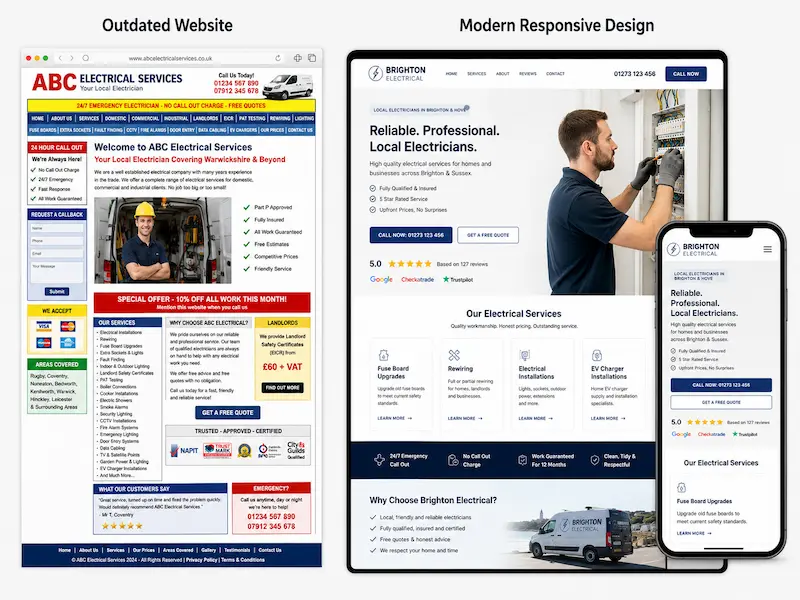
Customers judge your competence by what they see in the first three seconds. Fair or not, an outdated electrician website signals an outdated business. If your homepage has stock images of generic plugs, swirly fonts, gradient buttons, or a layout that looks crammed and busy, you're losing trust before anyone reads a word.
A modern trades site looks calm and confident. Clean layout, real photos of you and your van, a clear logo, plenty of white space, and one obvious thing to do on every page.
Picture two websites side by side. One has Comic Sans, clip-art lightning bolts, and a tiled background. The other has a clear hero image of the electrician on a real job, three obvious service buttons, and a "Call now" sticky bar at the bottom. Same skills behind the business. Very different perception.
2. It Takes Forever to Load on Mobile
Over 70% of local trades enquiries now come from mobile. If your site takes more than 3 seconds to load on a phone, most visitors are already gone. Google also uses page speed as a ranking factor for local search, so a slow site quietly sinks your visibility too.
How fast is fast enough? Under 3 seconds is the benchmark. Under 2 is great. Run your URL through Google PageSpeed Insights for a free check, then try loading your site on your phone using mobile data while standing away from home Wi-Fi. That's the experience your customers actually get.
3. It's Painful to Use on a Phone
Speed is one thing. Usability is another. A site can technically "work" on mobile while being miserable to use. Tiny text you have to pinch to read, buttons stacked too close together, a phone number that isn't clickable, a contact form with 9 fields and a tiny "submit" button.
Try the thumb test. Could a customer, holding a kettle in one hand, book you using only their thumb on the other? If they can't tap your number, scroll smoothly, and send a message in under 30 seconds, you have a mobile UX problem.
Mobile-friendly websites win more local jobs for electricians and a clunky mobile experience is one of the fastest ways to lose them.
4. Your Phone Number Isn't the Star of the Show
Your phone number should be the most obvious thing on every single page. Top right of the header, sticky on mobile, repeated in the footer, and paired with a clear instruction like "Call for a free quote, no call-out fee."
Some electricians worry it looks tacky to plaster the number everywhere. It doesn't. It looks helpful. Customers in a stressful situation, a kitchen with no power or a sparking socket, don't want to hunt around for a "Contact" menu. They want a big tap-to-call button right there.
Add a WhatsApp button and a short contact form too. Different customers prefer different channels. Give them all three. For genuinely urgent work, this matters even more, which is why we wrote about emergency electrician websites that actually win calls.
5. Visitors Can't Tell What You Actually Do
"We do all electrical work" is the laziest line on the internet and it's on thousands of electrician websites. It tells Google nothing and it tells customers nothing.
Each main service needs its own dedicated page. EV charger installation. Fuse board upgrades. EICR testing. Full and partial rewires. Emergency call-outs. Smart home wiring. Commercial work. Each page should explain what the service is, who it's for, what it costs roughly, and why someone should pick you.
Compare two approaches. Site A has a single "Services" page listing 12 things in bullet points. Site B has 6 individual service pages, each properly written, each ranking on Google for that specific search. Site B wins every time, both for SEO and for customer clarity.
6. No Reviews, Testimonials, or Proof You're Real
People don't believe claims without evidence. If your site says "trusted local electrician with 20 years of experience" but shows no reviews, no photos of past work, no certifications, you're asking for blind trust from a stranger who's about to let you into their home.
Trust signals to add: an embedded Google reviews widget, NICEIC, NAPIT, or Part P logos near your call-to-action, a "Recent jobs" page with before-and-after photos, public liability insurance details, and any Checkatrade or TrustATrader badges you have.
Your Google reviews are great. But customers shouldn't have to leave your site to find them. Bring the proof to them.

7. You're Invisible in Local Google Searches
Try this right now. Open an incognito tab and search "electrician [your town]." Are you on the first page? In the map pack? Anywhere?
If not, your local SEO is the problem. Common gaps include an unclaimed or thin Google Business Profile, no town or city names anywhere on the site, missing "areas we cover" pages, no location schema markup, and no local content like neighbourhood guides or town-specific service pages.
Being on Google Maps is the start of local SEO, not the finish. Customers searching at 9pm on a Tuesday are filtering by trust and relevance, and Google is filtering for them. If you're not telling Google clearly where you work, you won't show up. We go deeper on this in our guide to SEO for electricians and how to win more local customers.
8. Your Website Hasn't Been Updated in Years
When was the last time you touched your site? If the answer is "I think 2019", that's a flashing red light. Outdated sites usually have old prices, services you no longer offer, no mention of EV charging or solar PV, broken links, expired SSL certificates, and copyright dates from three years ago in the footer.
Google rewards freshness. So do customers. A site that hasn't been touched in years signals that the business might not even be active anymore. If your site still advertises "rewires from £999" when prices have moved on, customers either think you're cheap and cutting corners, or they assume the site is abandoned.
This is one of the clearest signs an electrician website refresh, or a full redesign, is overdue.
9. You Have No Idea Where Your Enquiries Actually Come From
If someone asked you today how many enquiries your website generated last month, could you answer with a real number? If you can't, you're flying blind.
You don't need to be a data scientist. The basics are Google Analytics 4 (free), call tracking on your main number, and email notifications when your contact form is filled in. With those three, you'll know how many people visit, what they do, and which jobs the website is actually winning.
A simple low-tech start? Just ask every new customer for a month: "How did you find us?" You'll quickly see whether the website is pulling its weight or quietly losing.
What a Proper Electrician Website Redesign Actually Includes
So you've ticked a few boxes. What does fixing it actually involve? A proper redesign isn't just a new coat of paint. It rebuilds the site around how customers really decide to call you. Here's what to expect from any decent web designer.
Clear, Service-Focused Pages That Sell for You
Every main service gets its own page. Each one should cover what the service is, the problems it solves, who it's for, the areas you cover, your trust signals, FAQs, two or three reviews, and a strong call-to-action.
Quick example. An "EV Charger Installation in Reading" page might open with the problem (slow public charging, wanting to charge at home), explain what you fit (7kW and 22kW units, OZEV-approved installers), list the brands you work with, show two photos of installs, embed three reviews, and end with a sticky "Get a free quote" form. Specific, useful, and built to rank.
Trust Signals on Every Page
Don't bury your certifications on an "About" page nobody visits. NICEIC, NAPIT, Part P, public liability insurance, years in business, real team photos, and a Google reviews widget should sit near every important call-to-action. In the footer. In the sidebar. Next to the contact form. Everywhere a customer is deciding whether to call.
Local SEO Built In From Day One
If you cover Reading, Wokingham, and Bracknell, you need three properly written area pages, not a single "areas we cover" list with town names dumped in. Each town page should mention local landmarks, common housing types, and genuine local context. Combine that with proper location schema, a fully optimised Google Business Profile, and NAP consistency (Name, Address, Phone matching everywhere online), and you'll start showing up where it matters.
This is exactly the kind of work we focus on at Nestweb. We build professional, SEO-optimised websites for small UK businesses including electricians starting from £700, with local visibility baked in from day one rather than bolted on later.
Strong, Obvious Calls to Action
Every page needs an obvious next step. A sticky "Call now" bar on mobile. A WhatsApp button. A short 3-field contact form (name, postcode, message) instead of a 9-field interrogation. A clear response promise like "We reply within 1 hour during working hours."
Don't make customers choose between call, form, or WhatsApp. Offer all three and let them pick. Different people in different situations prefer different channels.
Built for Speed and Mobile
Modern hosting, properly compressed images, clean code, mobile-first design. The platform matters less than how it's built. WordPress, Webflow, or a custom build can all perform brilliantly if done well, and all of them can be slow and clunky if done badly. Aim for load times under 3 seconds, ideally under 2.
How Much Does an Electrician Website Redesign Cost in the UK?
The honest answer? It depends on what you actually need. Here are realistic UK ballparks.
DIY templates on Wix or Squarespace can run you £200 to £500 a year including hosting and a domain. Cheap and fast, but usually weak on SEO, slow to convert, and only as good as the day you finish it.
A freelance web designer building a simple custom site typically sits between £1,500 and £3,000. Better quality, more tailored, but SEO and ongoing support are often extras.
A full agency redesign with strategy, content, local SEO, and ongoing support usually runs £3,000 to £8,000+ depending on scope.
We've covered web design costs for UK small businesses in more depth here, so you can see exactly what changes at each price tier. At Nestweb we sit in the sensible middle, building professional electrician websites with proper SEO from £700, because we don't think small businesses should have to choose between cheap-and-broken or expensive-and-bloated.
Redesign vs. Refresh: Which One Do You Actually Need?
Not every site needs a full rebuild. Sometimes a refresh is enough.
A refresh works if the foundation is solid: decent platform, mobile-friendly, reasonable structure, but visuals look tired and content is outdated. You're talking new photos, rewritten service pages, a few new sections, updated reviews.
A full redesign is needed when the platform is ancient (old WordPress with abandoned themes, hand-coded HTML from 2014), the structure is broken, mobile is unusable, and there's no SEO foundation to build on.
A quick 3-question self-test:
-
Does the site work properly on mobile in under 3 seconds? If no, lean redesign.
-
Do you have at least one dedicated page per main service? If no, lean redesign.
-
Are you happy with the visuals and only want to update content? If yes, refresh.
How to Choose the Right Web Designer for Your Electrical Business
Once you decide to invest, pick carefully. Look for a designer or agency with trades experience or at least a portfolio of similar local businesses. Make sure SEO is included or clearly priced separately. Confirm you'll own the website outright when it's done, including the domain, hosting access, and all content.
Red flags to walk away from: locked-in monthly contracts where you never actually own the site, vague deliverables ("we'll make it look nice"), no SEO strategy mentioned, no portfolio, or pushy upsells before they've even seen your current site.
A few good questions to ask any web designer before signing:
-
Will I own the website and domain outright?
-
Is local SEO included? What exactly?
-
Can you show me electrician or trades websites you've built that rank well?
-
What happens if I want to make changes in 6 months?
-
How long will the project take and what do you need from me?
If you'd like a starting point for what good looks like, take a look at how we rebuilt BM Sparks' electrician website and what changed for their enquiries afterwards.
Frequently Asked Questions
How often should an electrician redesign their website? The general rule is every 3 to 5 years. Web standards, Google's algorithms, and customer expectations all shift fast. Sooner if your site has any of the major warning signs above: slow mobile, no local SEO, dated design, or no clear way to contact you.
Why is my electrician website not getting any enquiries? The top three causes are almost always poor mobile experience, weak or hidden calls-to-action, and zero local SEO. Fix those and enquiries usually start coming within weeks.
Can I redesign my electrician website myself using Wix or Squarespace? Yes, technically. The visuals can look great. The hard parts are local SEO, conversion design, and proper service page structure, and those usually need someone who's done it before. DIY works for very early-stage businesses. Once you're trying to compete locally, you'll feel the ceiling.
How long does an electrician website redesign take? A proper redesign with custom content and local SEO usually takes 4 to 8 weeks from kick-off to launch, depending on how quickly you can supply photos, reviews, and feedback.
Will a new website really get me more local customers? Only if it's combined with local SEO, a fully optimised Google Business Profile, and real reviews. A pretty new website on its own won't magically rank. The redesign is the foundation, not the whole strategy.
Do I need a separate page for every service and every town I cover? For your main services and key towns, yes. That's how local SEO works. You don't need a page for every village within 50 miles, but your 3 to 6 main service areas and 5 to 8 core services should each have their own properly written page.
Final Check: Is It Time to Redesign Your Website?
Quick recap. The 9 warning signs again:
-
Your site looks like it's from 2015
-
It's slow to load on mobile
-
It's painful to use on a phone
-
Your phone number isn't obvious everywhere
-
Visitors can't tell what you actually do
-
There are no reviews or trust signals on the site
-
You're invisible in local Google searches
-
The site hasn't been updated in years
-
You have no idea where enquiries come from
If you ticked 3 or more, it's time. If you ticked 6 or more, your website is actively costing you work every week. The longer you wait, the more jobs go to the electrician up the road whose site loads faster and looks more trustworthy.
Do a 10-minute audit right now. Open your site on your phone. Time the load. Check for a clickable phone number. Look for reviews above the fold. Scroll through and ask yourself: would I trust this business with my home?
If the honest answer is no, you already have your decision. For a fuller picture of what a modern, conversion-focused site for your trade looks like, see how we build a proper website for an electrician.
At Nestweb we build professional, SEO-optimised electrician websites for UK small businesses from £700, with local visibility, mobile-first design, and clear calls-to-action built in from the start. If you'd like a free 10-point audit of your current site, no obligation and no hard sell, just genuinely useful feedback, get in touch and we'll send it over within 48 hours.
Your next job is probably searching for you on Google right now. Make sure your website is ready to win it.