If you're an electrician with a website that's not bringing in calls, you're not alone. Most UK electricians have a site that sits there quietly while competitors get all the local jobs.
This guide walks you through exactly what SEO means for your business, what to do first, and what's actually worth your time. No jargon, no fluff — just practical steps you can take this week.
By the end, you'll know how to make Google show your business to people who are searching for an electrician in your area right now.
Why Most Electricians Are Invisible on Google (And How to Fix It)
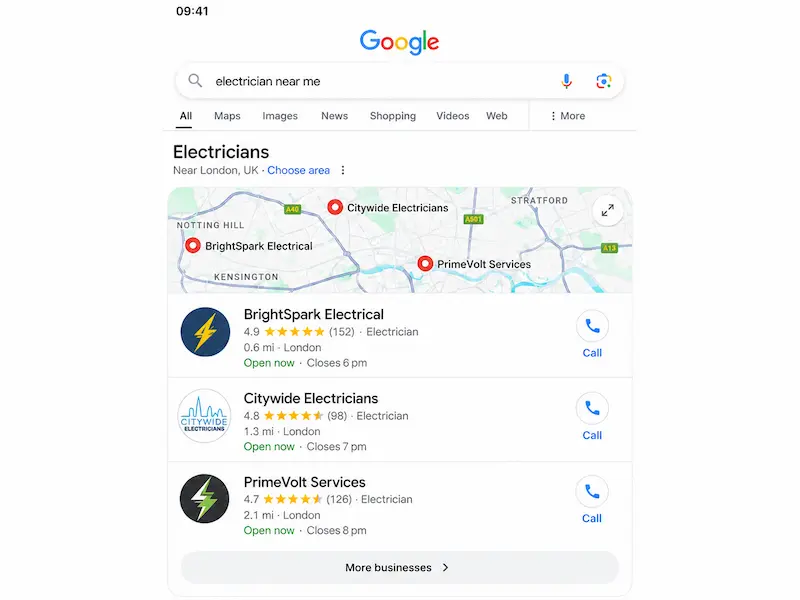
When someone's fuse board trips at 8pm on a Tuesday, they don't ask their mate for a recommendation. They pull out their phone and type "electrician near me" into Google.
That single phrase gets searched around 74,000 times every month in the UK. Multiply that by all the variations — "emergency electrician Manchester", "rewire quote near me", "PAT testing local" — and you're looking at hundreds of thousands of potential customers every month.
Now ask yourself an honest question: when those searches happen in your area, does your business show up?
For most electricians, the answer is no. And it's not because their work isn't good. It's because Google has no idea they exist, or it knows they exist but doesn't think they're worth showing.
Word of mouth still matters, but it's no longer enough. Even customers who get your name from a friend will Google you before calling — and if they can't find you, or your competitor's listing looks more polished, you've lost the job before the phone even rings.
The gap between having a website and being found is exactly what SEO closes.
What SEO Actually Means for an Electrician
SEO stands for Search Engine Optimisation. In plain English, it's the process of making your website and online presence more attractive to Google, so it shows your business when people search for what you offer.
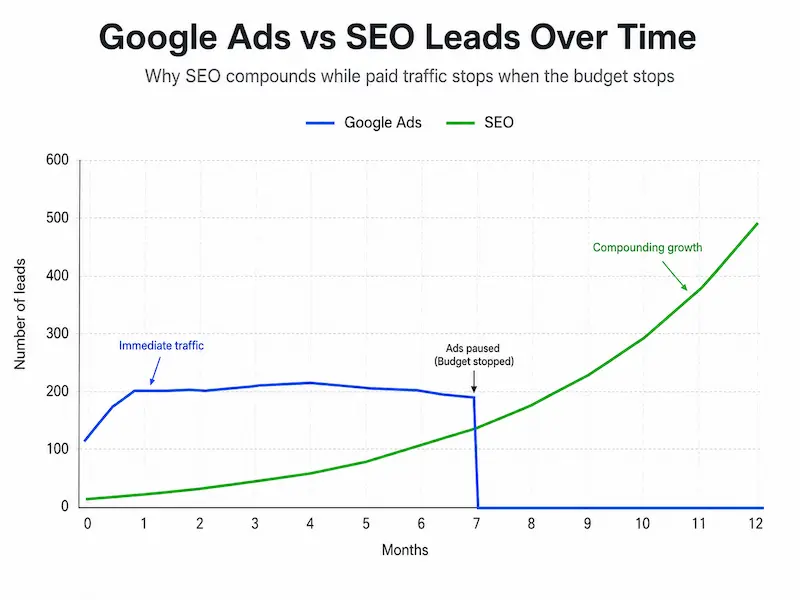
It's not the same as Google Ads. Ads are paid, when you stop paying, you stop appearing. SEO is about ranking organically, which means once you get there, the leads keep coming without paying per click.
Here's the good news: as an electrician, you don't need to compete with the entire internet. You only need to compete with other electricians in your service area. That's a much smaller battle, and it's one you can absolutely win.
Local SEO vs General SEO — What's the Difference?
General SEO is what big national brands fight over. Think of websites trying to rank for "best running shoes" worldwide.
Local SEO is different. It targets people searching for a service in a specific place. "Electrician near me", "electrician in Leeds", "emergency sparky Birmingham" — these are local searches, and they're the only ones that matter for you.
The intent behind those searches is also completely different. Someone typing "what is an electrician" is probably a curious teenager. Someone typing "electrician near me" has a problem and wants it fixed today. Guess which one is your customer.
For tradespeople, local SEO isn't just a part of SEO, it's the whole game. You don't need to rank in Glasgow if you only work in Bristol.
Google Business Profile — Your Most Powerful Free SEO Tool
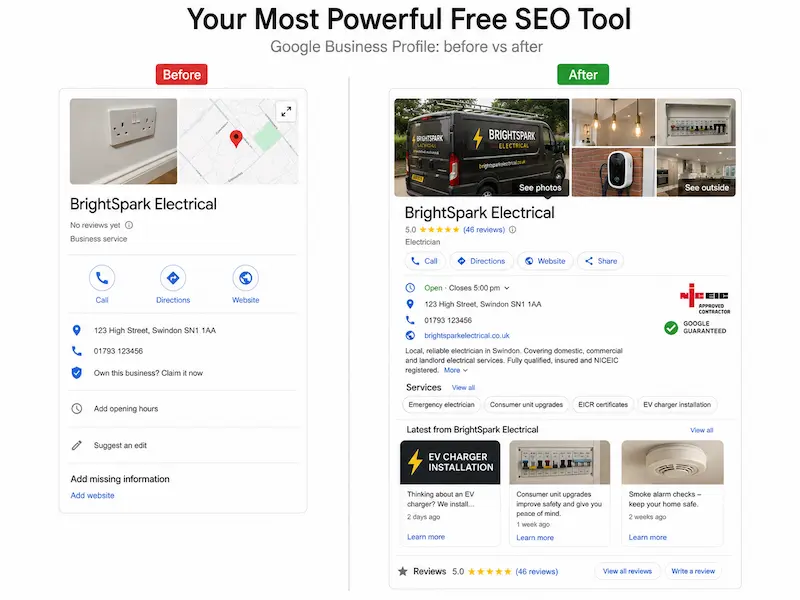
If you only do one thing after reading this article, do this: set up and properly optimise your Google Business Profile (GBP).
GBP is the free Google listing that shows up on the right-hand side when someone searches for your business, and more importantly, it powers the local "3-pack" — the three businesses Google highlights with a map at the top of local search results. Getting into that 3-pack is the single biggest lever for local visibility.
Setting it up takes 15 minutes. Optimising it properly takes a bit longer, but it's worth every second:
- Choose the right primary category ("Electrician" — not "Electrical Contractor" unless that's literally your trading name).
- Add every service you offer, separately. Fuse board replacement, EV charger installation, rewires, emergency call-outs — list them all.
- Upload real photos. Your van, your team, before-and-after shots of jobs. Stock photos don't count.
- Fill in your service area, opening hours, and phone number. Make sure they match your website exactly.
- Add posts regularly. Even a quick weekly update tells Google you're active.
A sparse GBP listing with one photo and a phone number won't rank. A complete listing with 30 photos, regular posts, and consistent reviews will leave your competition behind.
How to Get More Reviews (Without Being Pushy)
Reviews are one of the strongest local ranking signals Google uses. They also massively influence whether someone clicks your listing or your competitor's.
The hard part is asking for them. Most electricians feel awkward about it, so they don't bother. Then they wonder why their listing has 4 reviews and the firm down the road has 87.
Here's the simplest way to fix it: ask straight after the job, while the customer is happy. Send a short WhatsApp message a few hours later. Something like:
"Hi, really glad we could sort that out for you today. If you've got 2 minutes, a quick Google review makes a massive difference for a small business like ours. Here's the link: [your GBP review link]. No worries if not. Cheers!"
That's it. No pressure, just a genuine ask.
What about negative reviews? They happen. The trick is to respond calmly and professionally, never defensively. A polite reply that acknowledges the issue and offers to make it right often does more for your reputation than the original review.
Your Website — The Foundation of Your SEO
Your Google Business Profile gets you on the map. Your website is what convinces customers to actually call.
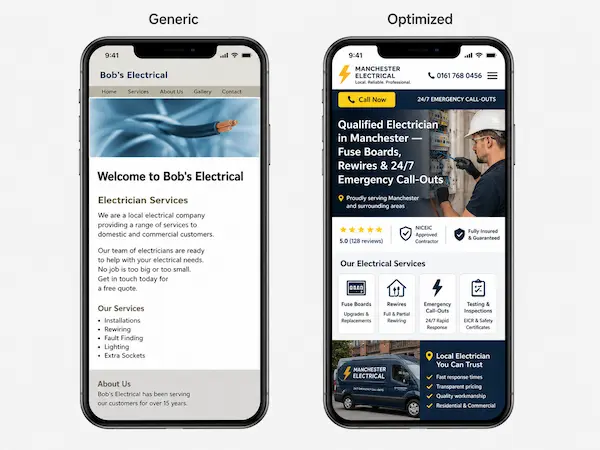
It's also what Google looks at to decide whether to rank you in the first place. A pretty website that loads slowly, doesn't work on mobile, or only has a single page about everything won't rank, no matter how good it looks.
A website that ranks for electricians has three things going for it: it loads fast, it works perfectly on a phone, and it has separate pages for each core service you offer. That's the foundation. Anything else is decoration.
Compare two homepages. One says: "Welcome to Bob's Electrical — we do all your electrical needs."
The other says: "Qualified Electrician in Manchester — Fuse Boards, Rewires & 24/7 Emergency Call-Outs."
Which one tells Google (and a stressed-out homeowner at 9pm) exactly what you do and where you do it? That's the difference a small wording change can make.
At Nestweb, we build SEO-optimised websites specifically for electricians in the UK, from £700 designed from day one to actually bring in calls, not just look nice. We've put together a guide on how to get your website to show up on Google if you want to dig deeper into the technical side.
On-Page SEO for Electricians — The Basics That Actually Move the Needle
On-page SEO is everything you control on your own website. Don't overthink it. Here's what actually matters:
Page title. This is the clickable headline that shows in Google results. For each page, write something like: "Emergency Electrician in Manchester | Available 24/7 | Bob's Electrical". Service + location + business name. That's the formula.
Meta description. A short summary (under 160 characters) that appears under your title in search results. It doesn't directly affect rankings, but it massively affects whether people click.
H1 heading. The big heading at the top of the page. Include your service and location naturally — "Emergency Electrician in Manchester", not just "Welcome".
Body copy. Mention your service, your location, and the surrounding areas you cover, naturally and in plain English. Don't stuff keywords. Write like you'd explain the service to a customer on the phone.
You don't need to mention "electrician Manchester" 47 times. You need to write a clear, useful page that genuinely answers what someone is searching for.
Why Your Website Needs Separate Pages for Each Service
This is the single biggest missed opportunity for trade businesses online.
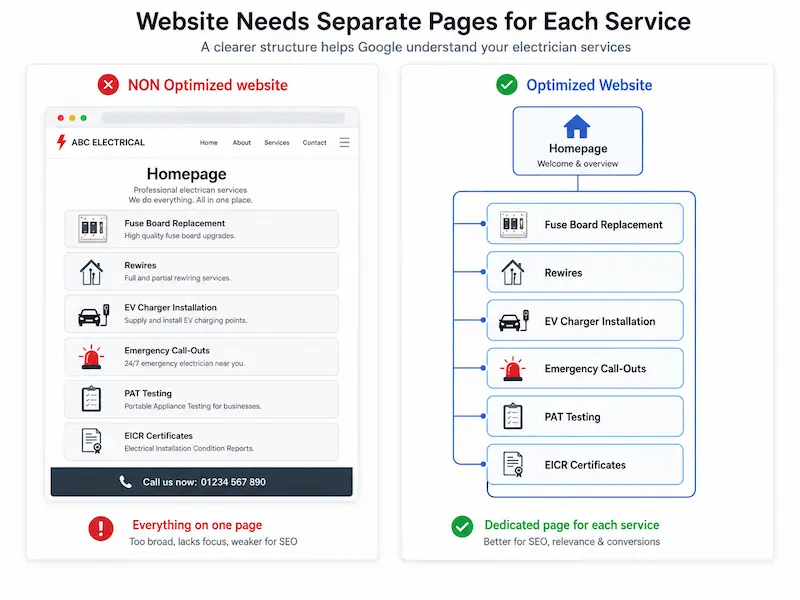
If you cram every service onto one page — rewires, fuse boards, EV chargers, lighting, PAT testing — Google has no idea what your site is actually about. It can't rank you well for any of them.
Instead, create one focused page per service. Even if you only offer three core services, that's three pages, each with a real chance of ranking for its own keyword.
A solid service page structure looks like this:
- Clear H1 ("Fuse Board Replacement in [Your City]")
- A short explanation of what the service is and when customers need it
- Why someone might need it now (signs of a faulty board, regulation changes, etc.)
- The areas you cover
- A clear call-to-action — phone number, contact form, or both
This doesn't make your site messy. It makes it useful. And every extra service page is another door Google can send customers through.
Local Citations — Why Consistency Across the Web Matters
A "citation" is just a mention of your business name, address, and phone number (NAP) on another website. Things like Checkatrade, Yell, Trustpilot, Thomson Local, Bark.
Google uses these citations to verify your business is real and to confirm where you operate. The catch is consistency. If your address says "12 High Street" on Yell but "12 High St." on Checkatrade and "12a High Street" on your website, Google gets confused — and confusion costs rankings.
Five UK directories every electrician should be listed on consistently:
- Checkatrade — high authority, customers actively use it
- Yell — old-school but still trusted by Google
- Trustpilot — reviews carry weight beyond just SEO
- Thomson Local — solid local citation source
- Bark — generates leads on top of citation value
If you've moved premises or changed phone numbers in the last few years, do a quick search for your business and update any old listings. It's tedious but takes one afternoon and pays off for years.
How Long Does SEO Take for an Electrician — And Is It Worth It?
Let's be honest, because plenty of agencies aren't.
Google Business Profile results can show up within a few weeks. Optimise your listing properly, get a few reviews, and you can start appearing in the local 3-pack within 30-60 days.
Website SEO takes longer — usually 3 to 6 months before you see meaningful organic traffic, and 6 to 12 months for it to really compound. There's no shortcut, and anyone telling you otherwise is selling you something.
So is it worth the wait? Compare it to Google Ads. Spend £500/month on ads and you'll get leads — but the second you stop paying, the leads stop dead. Invest the same effort into SEO and a year from now you'll have a website that brings in free leads every single month, indefinitely.
Most successful electricians do both: ads for short-term leads, SEO for long-term growth. One of our clients, BM Sparks, is a great example of how this plays out for a real electrical business.
Do Electricians Need to Hire an SEO Agency?
Short answer: it depends on how much time you have and how serious you are about growing.
You can absolutely do the basics yourself: optimise your Google Business Profile, ask for reviews, write decent service pages, and sort out your citations. That alone will put you ahead of 80% of your competition.
What an agency adds is the harder stuff — technical SEO fixes, ongoing content, building backlinks from quality sites, tracking what's working and what isn't. If you're booked solid with jobs and don't have time to think about meta descriptions, hiring help makes sense.
When choosing someone, watch for:
Red flags: Promises of "page 1 in 30 days." Vague reports full of jargon. No examples of work with trade businesses. Locked-in contracts longer than 6 months.
Green flags: Real case studies from electricians, plumbers, or builders. Clear monthly reporting in plain English. Willingness to explain exactly what they're doing. Reasonable pricing for what's delivered.
For most small electrical businesses in the UK, a good website plus consistent local SEO work is enough to dominate your area. At Nestweb, we specialise in exactly that, building affordable, SEO-ready websites for electricians and other tradespeople without the agency markup or the confusing jargon.
Wrapping Up: Your SEO Action Plan
Here's the short version of everything above:
- Claim and fully optimise your Google Business Profile this week.
- Set up a simple, repeatable system for asking customers for reviews.
- Make sure your website has a separate page for each core service, with proper titles, headings and location keywords.
- Get listed consistently on the main UK directories — same name, same address, same phone number everywhere.
- Be patient with website SEO. Three to six months of consistent work beats six months of Google Ads spend, every time.
You don't need to do everything at once. Pick one thing this week, do it properly, then move to the next.
Not sure where to start? We help UK tradespeople get found on Google without the jargon. [Get a free website review →]
Frequently Asked Questions
How long does it take for an electrician to rank on Google? Google Business Profile results can appear in 4–8 weeks with proper optimisation. Website rankings typically take 3–6 months to gain traction and 6–12 months to compound into steady organic leads. Patience and consistency matter more than speed.
What keywords should an electrician target for local SEO? Focus on service + location combinations. Examples: "emergency electrician [city]", "fuse board replacement [city]", "rewire quote [area]", "electrician near me", "EV charger installation [city]". Always pair the service with a location to capture searchers who are ready to book.
Is Google Business Profile free to use? Yes, completely free. There's no paid version, and Google doesn't charge for any feature within it. It's the highest-leverage free marketing tool available to any electrician — and far too many tradespeople either don't have one or haven't filled it in properly.
Can I do SEO myself or do I need to hire someone? You can absolutely handle the basics yourself: GBP optimisation, asking for reviews, writing service pages, and managing directory listings. If you want technical fixes, ongoing content, or backlink building, an agency or freelancer will save you time and accelerate results.
How important are customer reviews for SEO? Very. Reviews are one of the top three local ranking factors. They also influence click-through rates dramatically. A listing with 50 reviews at 4.8 stars will get more clicks than a competitor with 5 reviews, even if both rank in the same position.
What's the difference between SEO and Google Ads for electricians? Google Ads are paid — you pay for every click and the leads stop the moment you stop paying. SEO is organic — you invest time or money upfront, then earn free leads for months or years afterwards. Most successful electricians use both: Ads for immediate results, SEO for long-term growth.