If you're a UK electrician and your website is sitting there looking tidy but bringing in almost no calls, you're not alone. Most electricians blame Google, bad luck, or the time of year, when the real problem is usually the website itself.
In this guide, you'll discover the 9 most common electrician website mistakes that quietly kill enquiries, even on sites that look professional at first glance. We'll walk through each one, explain why it costs you leads, and show you exactly what to fix.
By the end, you'll be able to audit your own site in about 15 minutes and know whether you need a few small tweaks or a proper redesign. No jargon, no fluff, just practical advice that works for UK electrical businesses.
Why Your Electrician Website Isn't Bringing in Enquiries (Even Though It "Looks Fine")
There's a huge gap between having a website and having a website that actually generates work. A site can look modern, have nice photos, and still lose almost every visitor who lands on it.
Research consistently shows that local service businesses lose around 70% of potential leads to poor website experiences. Slow loading, hidden contact details, and weak calls to action all contribute. The frustrating part? Most owners have no idea this is happening.
Here's a real scenario we see often. An electrician spends £300 a month on Google Ads, drives 400 clicks to his homepage, and gets one call a week. The reason isn't Google. It's that his phone number is buried in the footer, the page takes six seconds to load, and there isn't a single review visible above the fold.
The good news is that every one of these problems is fixable. Let's go through them.
The 9 Most Common Electrician Website Mistakes
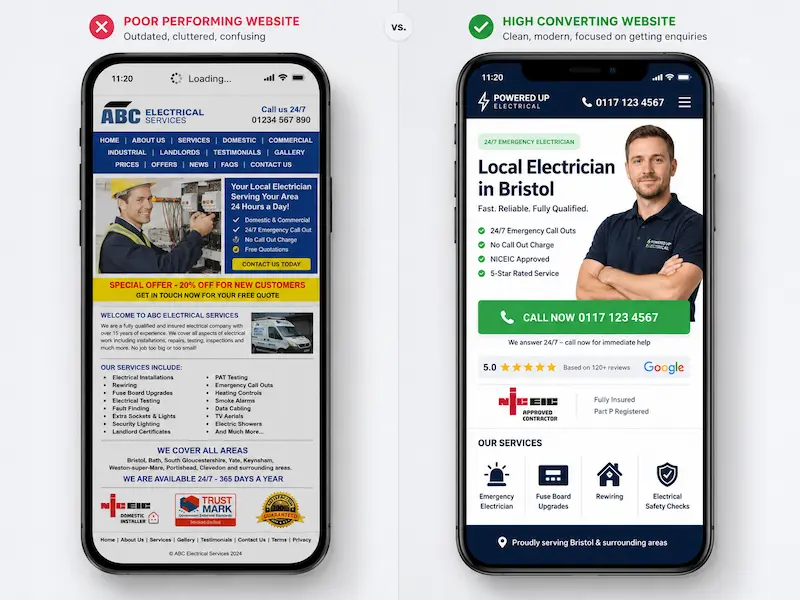
The mistakes below are based on patterns we see again and again across UK electrical contractor websites, from sole traders to ten-van operations. As you read through, tick off any that apply to your own site.
Don't worry if you spot several. Even fixing two or three of these typically lifts enquiries noticeably within a few weeks. You don't need to overhaul everything at once.
1. Your Phone Number Is Hidden (or Worse, Buried in the Footer)
If someone has just tripped their fuse box at 7pm or smelled burning behind a socket, they're not in the mood to hunt for a contact page. They want to tap and call, right now.
Your phone number should appear in the top right of every page, be clickable as a tel: link on mobile, and ideally stick to the top of the screen as visitors scroll. Putting it only on the contact page is one of the most expensive mistakes electrician sites make.
Around 60% of electrician website visitors arrive on mobile, and most are looking for fast, urgent help. A hidden number sends them straight back to Google to call the next electrician on the list.
2. Weak or Missing Calls to Action (CTAs)
A call to action is simply the next step you want your visitor to take. The problem is that most electrician sites either don't have one, or they have something dull like "Submit" or "Click here".
Strong CTAs are specific and benefit driven. Compare these:
-
Weak: "Contact us"
-
Strong: "Get a Free Quote in 24 Hours"
-
Strong: "Book Your Emergency Call Out"
-
Strong: "Request Your EICR Inspection Today"
Place CTAs in the hero section, at the end of each service description, and as a sticky button on mobile. People rarely feel pushed by clear options. They feel relieved that they know what to do next.
3. A Slow Website That Loses Visitors Before They Read a Word
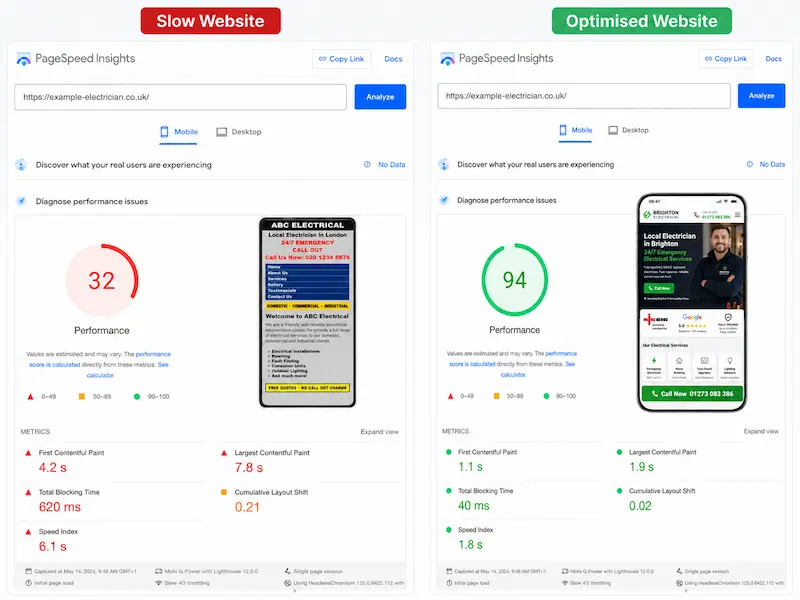
Speed matters for two reasons: Google uses it as a ranking signal, and your visitors have very little patience. Pages that take more than five seconds to load on mobile lose around 90% of visitors before they even see the content.
Common culprits are huge unoptimised images straight from a phone camera, cheap shared hosting, and bloated WordPress themes packed with features you'll never use. Run your site through PageSpeed Insights or GTmetrix (both free) to see where the bottlenecks are.
The working benchmark is under three seconds on mobile. If you're above that, you're losing leads every single day.
4. No Reviews or Social Proof on the Homepage
Electrical work involves trust at two levels: physical safety in the home and giving strangers access to your property. Without visible proof that other people have used you and been happy, visitors hesitate, and hesitation kills enquiries.
Pull testimonials from your Google Business Profile, Checkatrade, and Trustpilot. Show them near your main CTAs, in the hero section, and on every service page. Include the customer's first name, a rough location, and a photo where possible.
A simple line like "Rated 4.9 on Google from 87 local customers" placed next to your quote button can lift conversions by double digits. Don't assume visitors will go searching for proof. They won't.
5. Vague or Confusing Service Descriptions
"We do everything electrical" sounds helpful but actually puts people off. Customers want to know that you specifically handle their issue, whether that's an EICR, a fuse box upgrade, an EV charger install, a full rewire, or an emergency call out.
Each major service deserves its own dedicated page. That page should answer four questions:
-
What is this service in plain English?
-
When do you need it?
-
What does it roughly cost?
-
Why should I choose you for it?
Compare a thin page called "Domestic Electrical Services" with a focused one titled "EV Charger Installation in Manchester, From £750, NICEIC Certified". The second one ranks better, converts better, and qualifies leads better. A breakdown of the exact service pages your site needs is worth bookmarking if you want to plan this out properly.
6. No Local Pages for the Areas You Serve
UK customers search like this: "electrician Bromley", "emergency electrician near me", "EICR Sutton". If your site only has one "Areas We Cover" page listing 20 towns, you're competing against electricians with proper local pages, and you'll lose almost every time.
The right approach is a unique, genuinely useful page per major service area. Not just keyword swaps, but real local content: common jobs in that area, typical response times, a local testimonial, perhaps a note about parking or postcode coverage.
For example, an "Electrician in Bromley, Same Day Call Outs Across BR1, BR2, BR3" page with a short paragraph about local Victorian properties needing rewires will outperform a generic services page every single time. Google won't penalise you for this, as long as each page is genuinely different and helpful.
7. A Website That's Not Properly Designed for Mobile
"Responsive" and "designed for mobile" aren't the same thing. A responsive site reshuffles itself onto a small screen. A mobile first site is actually built around what someone with a power cut at 9pm needs to see in the first two seconds.
Common mobile failures include tiny tap targets, contact forms that won't autofill, phone numbers that aren't clickable, and hero text that gets pushed below a giant image. Looking at your site as the owner is different from looking at it as a stressed customer.
Open your site on your phone. Within two seconds, can you see your phone number, your main service, and a reason to trust you? If not, that's the fix.
8. Missing Credentials and Accreditations
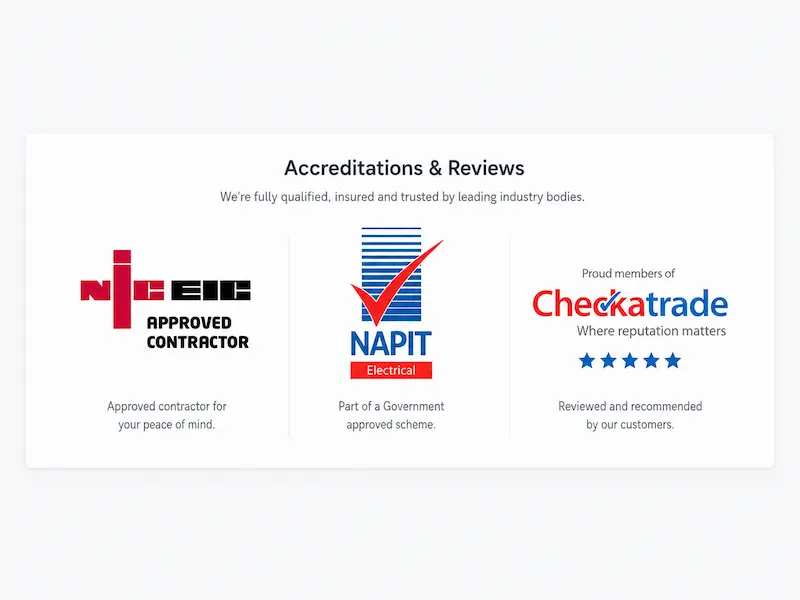
NICEIC, NAPIT, ELECSA, Part P registration, Which? Trusted Trader, TrustMark, Checkatrade. These badges aren't decoration. They're conversion tools.
Customers, especially those booking jobs over £500, increasingly check for accreditations before they pick up the phone. A "credentials strip" with four or five trust badges near the top of your homepage, along with your years of experience and a clear statement of public liability insurance (for example, "£5 million public liability"), reassures visitors immediately.
If you've completed thousands of jobs or have been trading for 15 years, say so. Concrete numbers beat vague claims every time.
9. No Clear Pricing Guidance Anywhere on the Site
Total price secrecy almost always hurts conversions. Visitors assume one of two things: either you're hiding prices because you're expensive, or you don't really know your numbers. Both kill trust.
You don't need to publish exact quotes. "From £X" ranges work brilliantly. For example:
-
EICR from £150
-
Fuse box upgrade from £450
-
EV charger installation from £750
-
Full rewire of a 3 bed house from £3,500
This filters out tyre kickers and brings in genuinely interested customers. Your competitors probably already know your rates anyway. The only people in the dark are the customers you actually want.
How to Audit Your Own Electrician Website in 15 Minutes
You don't need to be technical to spot most of these issues. Grab a coffee and run through this checklist:
-
Open your site on your phone. Is your number visible in under three seconds?
-
Run it through PageSpeed Insights. Mobile score above 70?
-
Count your service pages. Do you have one per core service?
-
Count your location pages. One per main town you serve?
-
Are reviews visible on your homepage, not just on a separate page?
-
Are your accreditation badges clearly displayed?
-
Is there a clear, specific CTA above the fold?
-
Is there any pricing guidance, even a "from" price?
-
Try the stranger test: ask a friend who's never seen your site to find your phone number in under five seconds.
Add Google Search Console and your Google Business Profile dashboard to that list to spot any deeper SEO or visibility issues. If you'd like a more detailed walkthrough, this guide on what every electrician website actually needs is a useful companion to this audit.
What a High Converting Electrician Website Looks Like Instead
When all of the above is done properly, your site stops being a digital business card and starts being a lead generation system. The key features are simple:
-
Loads in under three seconds on mobile
-
Phone number and CTA visible immediately, on every page
-
One page per service, one page per major location
-
Reviews and accreditations woven throughout
-
Clear "from" pricing and confident service descriptions
-
Forms that are short, autofill friendly, and mobile optimised
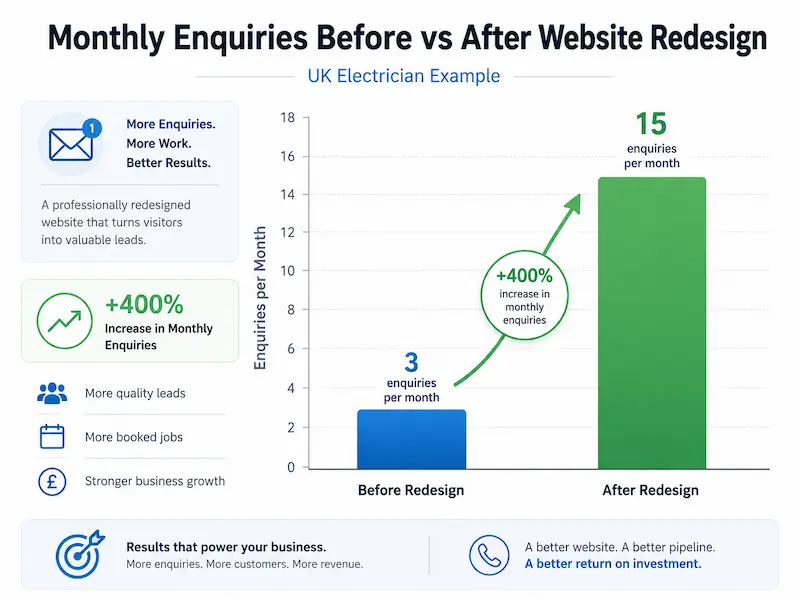
Most electricians who address six or more of the nine mistakes above see meaningful results within 30 to 60 days. We worked with a Surrey based electrician last year who went from 2 to 3 enquiries a month to over 15, simply by fixing his phone number visibility, adding three local pages, and putting reviews on the homepage. You can see the [LINK: full breakdown of that project in our case study - /case-studies/bm-sparks].
This is the kind of work we do at Nestweb. We build SEO optimised websites for UK small businesses, including electricians, starting from £700, so the investment pays for itself quickly once enquiries start coming in.
Should You Redesign Your Website or Just Improve It?
Not every site needs a full rebuild. Use this as a rough guide:
Small fixes are probably enough if:
-
Your site is under three years old
-
It's already fast and mobile friendly
-
It just lacks CTAs, reviews, or local pages
-
The structure is solid and the design is recent
A redesign is the right call if:
-
Your site is four or more years old
-
It's slow and not properly mobile optimised
-
You have no local pages or proper service structure
-
The design looks dated or untrustworthy
Think about the cost of doing nothing. If your average job is worth £250 and a better site brings just five extra enquiries a month at a 40% close rate, that's £6,000 in additional revenue per year. Across two or three years, the maths gets hard to ignore.
If you're not sure which camp you fall into, take a look at what a proper electrician website should include before deciding. And remember that pairing a strong website with a fully optimised Google Business Profile is one of the highest ROI moves you can make. We've covered how to optimise that here.
Conclusion: Fix the Leaks Before You Spend More on Marketing
The 9 electrician website mistakes we've covered are the silent reason most electricians don't get enquiries online. Slow speed, hidden phone numbers, weak CTAs, missing reviews, vague services, no local pages, poor mobile design, missing credentials, and zero pricing transparency. Fix even half of these and you'll see a real difference.
Spending more on Google Ads or SEO before plugging these leaks is like turning up the tap on a leaky bucket. Get the website right first, then the marketing budget works much harder.
At Nestweb, we specialise in building websites that turn visitors into paying customers for UK trade businesses, with prices starting from £700. If you'd like us to take a look at your current site and tell you exactly which mistakes are costing you the most leads, we offer a free, no obligation audit designed specifically for UK electricians.
Ready to stop losing enquiries? Get My Free Website Audit and find out exactly how many leads your current site is missing.
Frequently Asked Questions
Why is my electrician website not getting any enquiries even though it ranks on Google? Ranking and converting are two different jobs. Your site can show up in search results but still lose visitors because of slow speed, a hidden phone number, weak CTAs, or no reviews. If traffic is coming in but the phone isn't ringing, the issue is almost always on the website itself, not in Google.
How much does a professional electrician website cost in the UK? A properly built, SEO optimised electrician website in the UK typically ranges from around £700 to £3,000, depending on the number of service pages, local pages, and any integrations like booking systems. Cheaper template sites exist, but they rarely convert well or rank locally, which makes them more expensive in the long run.
Do I really need a separate page for each town I cover? Yes, if you want to rank for local searches like "electrician Bromley" or "emergency electrician Sutton". One generic "Areas We Cover" page won't compete against electricians who have proper local pages. Each location page should include genuinely local content, not just the same text with a different town name.
How long does it take to see more leads after fixing my website? Most electricians who fix the major issues, such as phone visibility, mobile speed, CTAs and reviews, see noticeable improvements within 30 to 60 days. Adding local service pages and proper SEO optimization typically delivers stronger results from month three onwards, as Google indexes and ranks the new content.
Should I use a website builder like Wix or hire a professional? DIY builders are fine for a quick presence, but they rarely rank well locally or convert at a high rate. For a trade business that depends on enquiries, a professionally built site usually pays for itself within months through extra jobs. If your website is genuinely your main source of leads, it's worth doing properly.
What's more important for getting leads, SEO or website design? They work together. Great SEO brings traffic, but a poorly designed site lets that traffic leak away without converting. The strongest results come from a website that is both technically optimised for Google and designed around real customer behaviour, with clear CTAs, fast loading, trust signals, and mobile friendly contact options.