If your electrician website has just one page called "Our Services" with a tidy bullet list, you're probably leaving real money on the table every single month. Google doesn't rank generic pages for specific local searches, and customers don't book electricians from vague pages either.
In this guide, you'll learn exactly which electrician service pages your website needs, why each one matters, and how to structure them so they bring in more local enquiries. We'll keep things practical and jargon free, with real examples from the UK market.
By the end, you'll know what pages to build, what to put on them, and why this small change can completely transform how many calls and bookings come through your site.
Why One Generic "Services" Page Is Costing You Local Customers
Here's the honest truth: when someone in Manchester types "emergency electrician near me" into Google at 11pm, Google doesn't want to show them your homepage. It wants to show them a page that talks specifically about emergency electrical work in Manchester.
Google's job is to match search queries to the most relevant page on the web. The rule of thumb every SEO professional follows is simple: one keyword equals one page. If you cram ten services into a single "Our Services" page, you're asking Google to rank that page for ten different topics at once. It almost never works.
Compare two scenarios. Page A is your "Our Services" page with bullet points listing rewiring, EICR, lighting, EV chargers and more. Page B is a dedicated page titled "Emergency Electrician Manchester" that explains response times, areas covered, common emergencies and how to book. Which one do you think Google will rank higher when someone searches "emergency electrician Manchester"? Page B, every time.
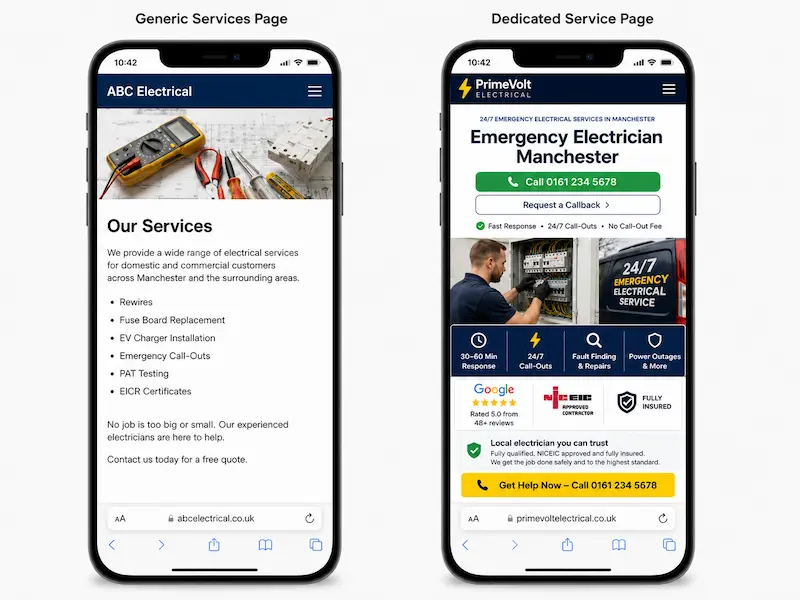
There's also a conversion angle. A visitor with a specific need who lands on a specific page feels understood. They get answers fast. They pick up the phone. A visitor stuck on a generic services page often clicks away to find a competitor whose page actually matches their problem.
How Service Pages Boost Both SEO and Conversions
Dedicated service pages aren't just an SEO trick. They're a sales tool. They work on two levels at once: they bring in qualified traffic from Google, and they turn that traffic into bookings.
Think of each service page as a focused conversation with one type of customer. A landlord looking for an EICR has very different concerns from a homeowner planning a full rewire. When you give each one their own page, you can speak to their exact situation and answer their specific questions.
The SEO Side: Targeting Specific Search Queries
Google looks at your page title, your H1, your meta description and your content to understand what each page is about. When all those elements line up around a single topic, Google has an easy job: it knows exactly which searches to show your page for.
This is especially powerful for long tail local keywords, which are longer, more specific searches that people actually type when they're ready to book. Three real examples:
- "rewiring cost UK" → wants a rewiring page with pricing
- "landlord EICR Birmingham" → wants a landlord certificate page mentioning Birmingham
- "EV charger installer near me" → wants an EV charger page with local signals
The pages that win these searches are almost never homepages or generic services lists. They're dedicated, focused pages that match the searcher's intent perfectly. This is what SEO professionals call search intent matching, and it's the single biggest reason service pages work.
The Conversion Side: Turning Visitors Into Bookings
Now imagine someone clicks your page after searching "fuse board replacement London". A dedicated fuse board replacement page can show them: an indicative price, how long the job takes, what's included, photos of past installations, a few reviews from happy customers and a clear "Book a free quote" button.
That visitor isn't browsing. They've already decided they need the service. Your job is to remove friction and build trust quickly. Trust signals like NICEIC or NAPIT certifications, real photos of your work, and genuine reviews do the heavy lifting here. A great phone number at the top isn't enough on its own. The whole page needs to reassure the visitor that you're the right choice.
The 7 Service Pages Every UK Electrician Should Have
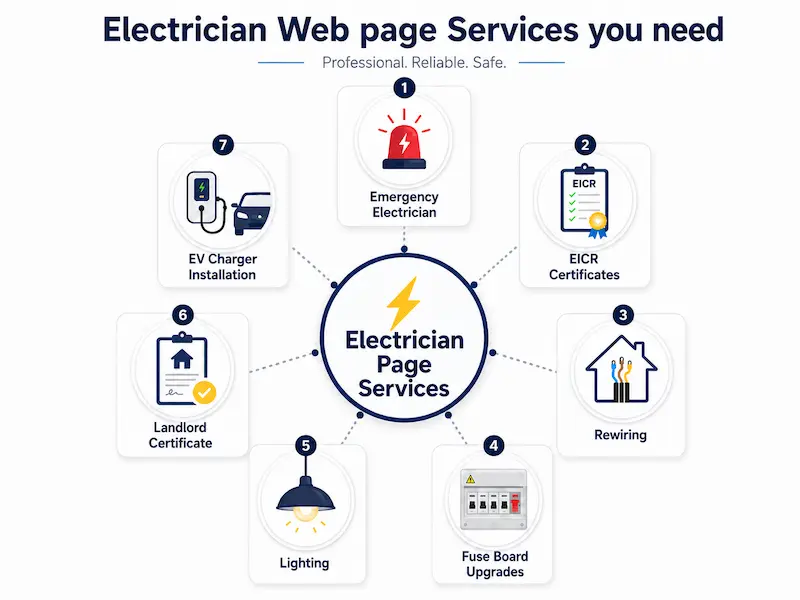
These seven pages cover the highest volume electrician searches across the UK. Build them well and you've covered the vast majority of local lead opportunities for your business.
Emergency Electrician Page
This page captures the highest intent traffic you'll ever get. Someone searching at midnight for an emergency electrician is ready to call right now.
Keep the most important information above the fold: a clear headline, your phone number, your response time and the area you cover. Something like "We respond within 60 minutes across Greater London" works perfectly. List the kind of emergencies you handle: power cuts, sparking sockets, burning smells, tripped circuits that won't reset.
People in panic don't read long pages, but they do scroll for reassurance. Make the page mobile fast, because almost all emergency searches happen on phones.
EICR Certificate Page
This page is gold for landlords and letting agents. Since the Electrical Safety Standards in the Private Rented Sector (England) Regulations 2020 came into force, landlords must arrange an EICR every five years. Many of them don't fully understand the rules and arrive at your page looking for clarity.
Explain what an Electrical Installation Condition Report actually is, who needs one, how often, what happens during the inspection and what it costs. A simple "What happens during an EICR inspection" section with bullet points works really well: visual inspection, dead testing, live testing, results, certificate issued.
Yes, you should explain the law on the page. It builds trust and answers the questions your visitor was already typing into Google.
Rewiring Service Page
Rewiring is a big decision, so the visitor lands on this page with lots of questions. Address them directly. List the warning signs that indicate a property needs rewiring: ceramic fuses, two pin sockets, wiring older than 25 years, frequent tripping.
Cover the practical concerns: typical UK pricing (often £3,000 to £8,000 depending on property size), how long the work takes, whether the customer needs to move out, and the certificates they receive at the end. A clean comparison table between "Full rewire" and "Partial rewire" with average times and prices makes the page feel genuinely useful.
A properly structured electrician website does this kind of clarity job naturally, because every page has a single focus.
Fuse Board Replacement Page
This is one of those technical sounding services that gets searched far more often than most electricians realise. Explain the difference between an old fuse board and a modern consumer unit, why upgrading matters (RCD protection, compliance with the 18th Edition Wiring Regulations), how long the job takes (typically half a day) and an indicative price.
Before and after photos work brilliantly here. Show a tired wooden fuse board with old rewireable fuses next to a clean, labelled modern consumer unit. The visual alone often convinces someone they should book.
Lighting Installation Page
Lighting covers a huge range of jobs, so structure this page by category: downlights, LED retrofits, outdoor and garden lighting, smart lighting (Hue, LIFX), commercial lighting. Talk about the benefits beyond looks: lower energy bills, increased property value, better security with motion sensor outdoor lights.
A small gallery of past projects works wonders here. Photos of kitchen spotlights, garden uplighters or a smart lighting setup show range and competence. Mention that some lighting work in special locations like bathrooms requires Part P notification, so visitors understand why a qualified electrician matters.
Landlord Electrical Certificate Page
You might wonder why you'd need this page if you already have an EICR page. The answer is simple: people search using different words. Some search "EICR certificate", others search "landlord electrical certificate". They're often the same service, but they're typed by different audiences with slightly different mindsets.
The landlord page should focus heavily on legal obligations, the consequences of non compliance (fines up to £30,000 per property), turnaround times, and any package pricing for letting agencies with multiple properties. A "What landlords need to know in 2026" box with key dates and a quick checklist is the kind of detail that gets bookmarked and shared.
EV Charger Installation Page
EV charger installation is one of the fastest growing services in the UK electrical industry, and demand keeps climbing. If you offer this service, having a dedicated page on your website is no longer optional.
So what should you actually put on this page? Think about the questions customers ask you on the phone every week, and answer them one by one:
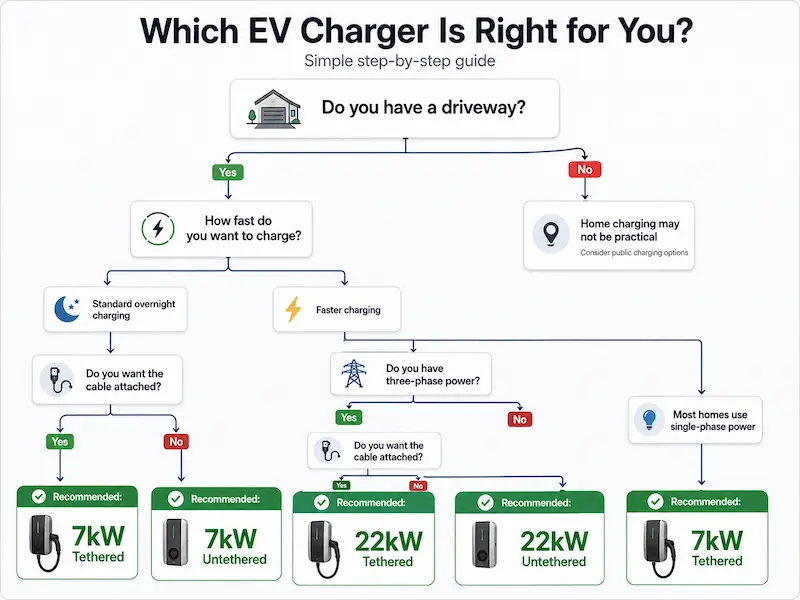
- What types of chargers do you install? Explain the difference between 7kW and 22kW, and between tethered (cable included) and untethered (bring your own cable). Most customers don't know these terms, so keep the language simple.
- Which brands do you fit? List the brands you work with, such as Ohme, Pod Point, Easee or Zappi. It builds trust and helps customers who've already chosen a brand know they're in the right place.
- Can they get a grant? Mention the OZEV EV chargepoint grant, which is currently available mainly for renters and flat owners. Many customers don't even know it exists.
- Will their home electrics cope? Reassure them that you'll carry out a load check on their existing supply and confirm smart meter compatibility before installation.
- How long does it take? A clear answer like "usually three to four hours" is exactly what visitors want to read.
A small trick that works really well is adding a simple decision tree like: "Do you have a driveway? Yes or No → Here's the right charger for you". It helps visitors get to their answer fast, without having to read the whole page.
How to Structure Each Service Page for Maximum Impact
Once you know which pages to build, you need a repeatable template. The structure below works for any electrician service page and consistently outperforms generic "we do everything" pages.
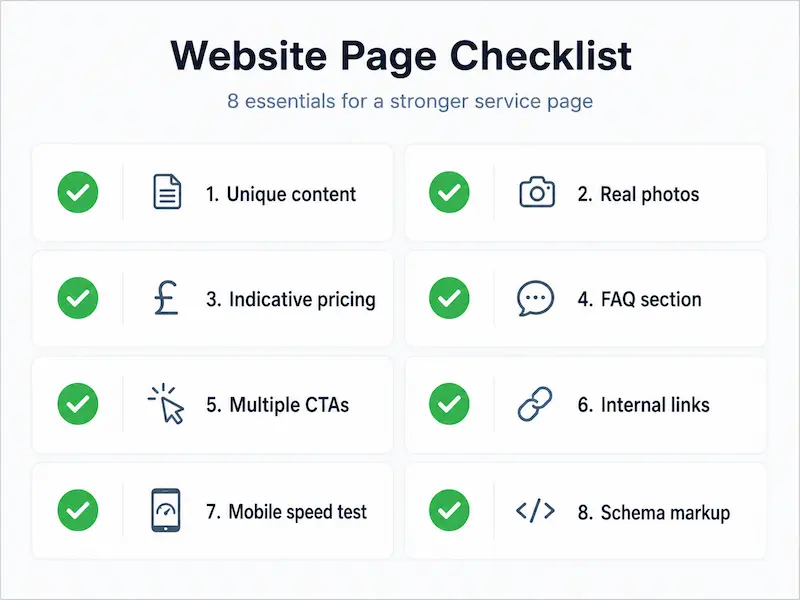
A high converting service page usually contains:
- H1 with keyword and city (e.g. "Emergency Electrician Birmingham")
- Short intro explaining what the page covers
- Benefits or trust bullets (response time, certifications, areas covered)
- Step by step process showing what happens when they book
- Indicative pricing (even just "from £X")
- FAQ section answering the top three to five questions
- Reviews and testimonials
- Multiple CTAs (phone, contact form, WhatsApp)
- Schema markup (Local Business or Service)
Aim for 600 to 1,200 words of genuinely useful content. Don't pad. Don't repeat. If you're a small business and the technical side feels overwhelming, this is exactly the kind of structured site we build at Nestweb: SEO optimised websites for UK small businesses starting from £700, designed to rank locally and convert visitors into customers.
Adding Local SEO Signals to Every Page
Local SEO is what separates an electrician website that ranks from one that disappears on page five of Google. Mention the city or county in your title tag, H1, and at least one H2. Embed a Google Map of your service area. Link clearly to your Google Business Profile.
If you genuinely serve multiple areas, create separate location pages for each one. A practical URL structure looks like this:
- /services/emergency-electrician/
- /services/emergency-electrician/manchester/
- /services/emergency-electrician/stockport/
Just don't fake it. Creating thin location pages for towns you've never worked in is what Google calls doorway pages, and they get penalised. Only build location pages for areas where you actually take jobs.
For more on this, read our guide to SEO for electricians which goes deeper into local ranking factors.
Common Mistakes Electricians Make With Their Service Pages
Even when electricians build service pages, they often make small mistakes that quietly kill the results. Here are the six most common ones to avoid:
- Copying service descriptions from other electricians' websites. Google detects duplicate content. Write in your own voice.
- Pages that are too short (under 300 words). Thin pages don't rank.
- No real photos. Stock images of generic electricians look fake. Use photos of your team and your jobs.
- No clear CTA. A page without a clear next step wastes the visit. Add phone, form, WhatsApp.
- No internal linking between related service pages. Link your EICR page to your fuse board page, your rewiring page to your consumer unit page.
- Ignoring mobile speed. More than 70% of local searches happen on mobile. A slow page loses customers fast.
If your current website was built years ago and ticks none of these boxes, you don't necessarily have to start from scratch, but a properly designed site will pay for itself many times over in extra bookings. At Nestweb, we build professional websites for electricians from £700 that come with these service pages already structured and SEO ready.
Do you want to turn your website into a steady source of local jobs? Get in touch and we'll show you exactly how it's done.
Conclusion
Generic websites are quietly losing customers every day. Specific, well structured service pages are the single most effective change a UK electrician can make to win more local jobs from Google. They match search intent, build trust, and turn visitors into bookings.
Start with the seven core pages: emergency electrician, EICR certificate, rewiring, fuse board replacement, lighting installation, landlord electrical certificate and EV charger installation. Add location pages where it makes sense. Follow the structure template, avoid the common mistakes, and your site will start working as a real lead generator instead of just sitting there.
If you'd rather have it done for you, see how much a professional small business website actually costs.
Frequently Asked Questions
How many service pages should an electrician's website have? At a minimum, build five to seven pages covering your core services. If you serve multiple towns or cities, add separate location pages for each area you genuinely work in.
Do I need a separate page for EICR and landlord certificates if they're similar? Yes. The two keywords are searched by different audiences. Landlords often search "landlord electrical certificate", while homeowners and businesses search "EICR". Two pages let you rank for both and speak to each audience clearly.
How long should each service page be? Aim for 600 to 1,200 words of genuinely useful content. Don't pad pages just to hit a word count. Quality and relevance matter far more than length alone.
Should I include prices on my service pages? Yes, where you can. Even an indicative "from £X" or a typical price range helps visitors trust you and qualify themselves before calling. If you don't want fixed prices, give a range based on the most common job types.
Will service pages really help me rank on Google for local searches? Yes, especially when combined with a fully optimised Google Business Profile, real reviews and consistent local citations. Service pages are the foundation. Local signals amplify them.
Can I just use AI to write all my service pages? AI is fine as a starting draft, but it shouldn't be your final output. Real service pages need your experience, your photos, your reviews, your local knowledge and your personal voice. That's what builds trust and ranks well long term.