Most people looking for an electrician will check your website before they call. If your site looks outdated, unclear, or hard to use on a phone, you might be losing enquiries every week without realising it.
This guide walks you through exactly what a good electrician website needs, from the headline at the top of the page to the trust signals that turn visitors into phone calls. No jargon, no fluff.
Whether you're a sole trader in London or run a small team across the UK, the same rules apply: your website is not just an online brochure, it's a tool for generating trust, calls, and local enquiries.
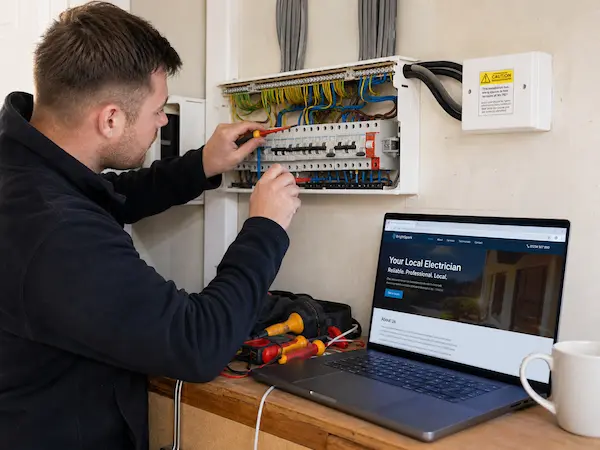
Why electrician website design matters
When someone needs an electrician, they usually do the same thing. They Google a few local options, open three or four websites in different tabs, and quickly decide who looks the most reliable.
They check your services, the areas you cover, your reviews, your photos, and any certifications you mention. If your site looks dated or confusing, they close the tab and move on. Most won't even tell you why they didn't call.
Your website is often the first impression before the phone call. That means good electrician website design isn't about looking flashy. It's about making people feel confident enough to pick up the phone within 30 seconds of landing on your page.
A clear headline that tells people what you do
The first thing visitors see at the top of your homepage is the most important part of the entire site. A weak headline like "Welcome to our website" tells people nothing.
Compare that with something like:
Qualified Electrician in Bromley for Emergency Repairs, Rewiring and EICR Certificates
In one line, this headline tells the visitor what you do, where you do it, and gives them a reason to trust you. A strong hero section should include:
- Your main service (or top three)
- The area you serve
- A signal of trust (qualified, NICEIC registered, 20 years' experience)
- A clear call-to-action, usually a phone number and a "Get a Quote" button
If a visitor can read your homepage for five seconds and still not understand what you do, the design has failed.
Easy ways for customers to contact you
This is where most electrician websites lose money. If someone has an electrical emergency, they should not have to search your website to find your phone number.
A well-designed electrician website should include:
- A phone number visible in the top right of every page
- A "Call Now" button that appears on mobile always visible
- A simple contact form (name, phone, message — that's it)
- WhatsApp, if you use it for enquiries
- CTAs repeated in strategic spots (after services, after reviews, in the footer)
- An email address that isn't buried at the bottom
People in a hurry don't scroll. They tap. Make tapping easy.
Trust signals that make people feel safe
This is probably the most important section of your entire website. Customers aren't just buying an electrical service. They're letting a stranger into their home. Trust matters more than price for most homeowners.
What to include on the page
- Google reviews (real ones, with names and dates)
- Certifications: NICEIC, NAPIT, Part P, City & Guilds
- Years of experience
- Public liability insurance details
- Areas covered
- Real photos of you, your van, and your work
- Guarantees on workmanship
- Phrases like "fully qualified", "insured", "trusted local electrician"
A short "About" section with a real photo of you in your work gear is worth more than three paragraphs of generic copy. People want to see who's coming to their door.
A services section that matches what people search for
Writing "Electrical Services" on your homepage is too vague. Most people don't search like that. They search for the exact problem they have.
Your services section should reflect the real terms people type into Google:
- Emergency electrician
- Electrical repairs
- Rewiring
- Fuse board replacement
- EICR certificates
- Lighting installation
- EV charger installation
- Landlord electrical certificates
- Commercial electrical work
Each main service deserves its own page, not just a bullet point. A dedicated page for "EICR Certificates in your town" is much more likely to rank on Google than a single homepage that mentions everything in one line.
This is something we focus on at Nestweb when we build website design for electricians every service page is structured to match how real customers search.
Local SEO and service area pages
Good design and good visibility on Google go together. A beautiful website nobody finds is just an expensive online business card.
Your electrician website should make it crystal clear:
- Which city or town you're based in
- Which areas you cover
- Your NAP: name, address, phone number (same information everywhere)
- A link to your Google Business Profile
- A map or coverage area image
- Local pages for each town you serve
A page for "Emergency Electrician in Bromley" is usually more useful than a generic page saying "We cover London". Local pages help Google understand exactly where you work and help customers feel like you actually know their area.
If you want to dig deeper into the visibility side, this guide on how to get your website found on Google covers the basics in plain English.
Real photos and project examples
Stock photos of generic electricians in hard hats fool nobody. Real photos build instant credibility.
A good electrician website should include:
- Photos of real jobs (consumer units, lighting, EV chargers, rewiring)
- A photo of your van
- Photos of you and your team
- Before and after shots
- Short mini case studies describing the job, the area, and the outcome
You don't need a professional photographer. A clean, well-lit photo from your phone is better than a perfect stock image. People want to see proof, not polish. A good electrician website case study shows how real photos and clear project descriptions can lift conversions noticeably.
Mobile-friendly design
Most electrician enquiries come from mobile, often from someone standing in a kitchen with no power. If your site is hard to use on a phone, you're losing those calls.
A mobile-friendly electrician website should have:
- Fast loading
- Big, tappable buttons
- Click-to-call numbers
- Easy-to-read text without zooming
- A simple form with minimal fields
- A clean menu that doesn't overwhelm
Open your own website on your phone right now. If you have to pinch to zoom, or if it takes more than three seconds to load, that's where you're losing money.
Fast loading speed
Speed is part of design, even though it's invisible. A faster website gives visitors a better experience and makes it easier for them to contact you quickly.
What affects loading speed:
- Image optimisation (compressed, properly sized)
- Lightweight code (no bloated templates)
- Good hosting
- Few unnecessary plugins
- Mobile performance
This is one of the reasons we at Nestweb build websites for UK small businesses from £700, focused on clean code and real speed rather than heavy templates that look impressive but load like glue.
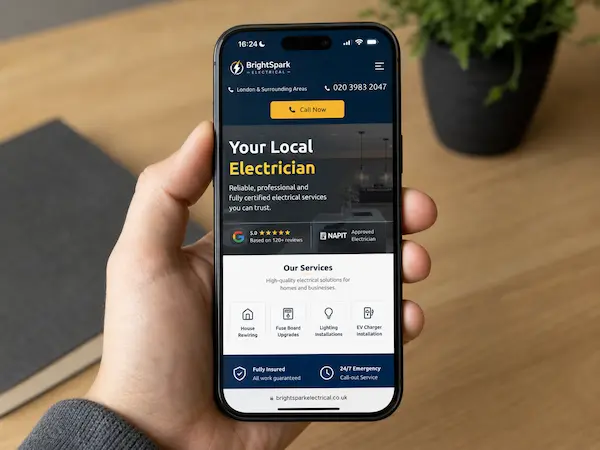
A simple structure for an electrician website
You don't need 30 pages. A focused structure works better than a sprawling one.
Standard structure
- Home
- Services
- Emergency Electrician
- EICR Certificates
- Rewiring
- Areas Covered
- Reviews
- About
- Contact
Smaller five-page version
- Home
- Services
- Areas Covered
- Reviews
- Contact
Pick whichever fits your business. Both can convert well if the content is clear and the CTAs are in the right places.
Common mistakes electricians make with their websites
After looking at hundreds of electrician sites in the UK, the same mistakes come up again and again:
- A site that looks like it was built in 2014 and never updated
- Phone number hidden somewhere in the footer
- No reviews visible on the homepage
- Vague services like "all electrical work undertaken"
- No clear list of areas served
- Stock photos that look obviously fake
- Slow loading on mobile
- No call-to-action buttons
- No proof of past jobs
- No connection to the Google Business Profile
If you spot two or three of these on your own site, that's where to start fixing things.
How much does an electrician website cost?
The cost of an electrician website depends on the number of pages, design quality, SEO setup, content, and support included. A basic five-page site is very different from a fully optimised site with local pages, photography, and ongoing SEO.
I've written a full guide on how much a small business website costs in the UK if you want a realistic breakdown without sales pressure.
For reference, at Nestweb we build professional, SEO-optimised websites for UK small businesses starting from £700, including the structure, speed, and local pages an electrician actually needs.
Final thoughts
A good electrician website doesn't need to be fancy. It needs to do four things well:
- Tell people what you do in one line
- Make it easy to call you
- Show enough proof that people trust you
- Load quickly and work on a phone
If your site does all four, you'll convert more of the visitors you already have, even before you start thinking about SEO and Google rankings.
If you're an electrician in the UK and want a website that actually generates calls instead of just sitting there, take a look at our website design for electricians page. We focus on small, fast, locally-optimised sites built for tradespeople who don't have time to manage anything complicated.
FAQ
What should an electrician website include?
At a minimum: a clear headline, your main services, areas covered, real photos, Google reviews, certifications, a visible phone number, and a simple contact form. Anything else is a bonus.
How long does it take to build an electrician website?
A focused five-page site usually takes two to four weeks, depending on how quickly content and photos are provided. Larger sites with multiple service and area pages take longer.
Do I need a separate page for each service?
For your main services (emergency, EICR, rewiring, EV charging), yes. Dedicated pages perform much better on Google than a single combined services page.
Is a website still worth it if I get most jobs from word of mouth?
Yes. Even people who hear about you through a friend will Google your business before calling. A weak or missing website can lose you those referrals.
How do I get my electrician website to show on Google?
Local SEO, accurate Google Business Profile, service area pages, real reviews, and consistent business details across the web. The basics matter more than fancy tactics.